





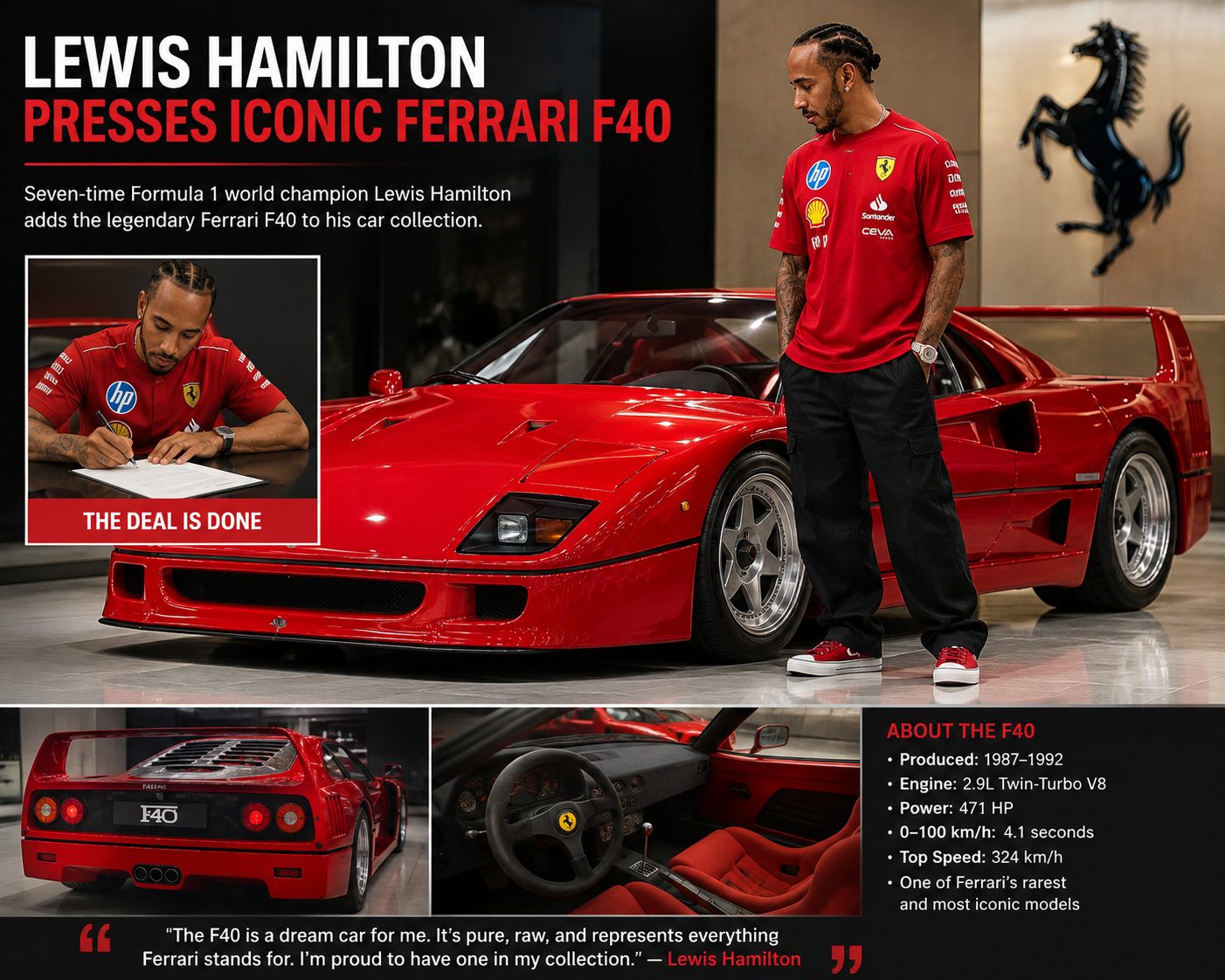
Lewis Hamilton Ferrari F40 Purchase: Worth It? Smart Facts
Lewis Hamilton Ferrari F40 purchase news has finally turned a long-running dream into reality. On August 31, 2026, Hamilton revealed that he now owns a Ferrari F40 after finding an example that had reportedly been sitting in a garage for more than 30 years.
The timing makes the story even more interesting. Hamilton sold his previous car collection in 2025 and said the F40 was the one car he would still want. Reuters reported at the time that he described the F40 more like a piece of art than simply another car.
Now that the Lewis Hamilton Ferrari F40 purchase is confirmed, the bigger question is what makes this particular car so meaningful. The answer goes well beyond its badge, performance, or potential collector value.
Lewis Hamilton Ferrari F40 Purchase Explained
The Lewis Hamilton Ferrari F40 purchase came after Hamilton had already decided to step away from owning a large collection of cars. His comments in 2025 made the F40 sound like the exception he couldn’t quite let go.
Hamilton later revealed that he found his F40 covered in dust after it had been stored for more than three decades. Rather than simply putting it back on the road, he took the car to Maranello for an extensive restoration by Ferrari engineers and mechanics.
That detail changes the story. He didn’t just buy a polished collector car from a showroom. He found a neglected piece of Ferrari history and chose to bring it back to life.
Why the Ferrari F40 Means So Much
Hamilton has spoken about wanting an F40 since childhood. His connection with the model became especially visible when he posed beside one at Ferrari’s Fiorano circuit during his public arrival at Ferrari in January 2025.
For Hamilton, the F40 also represents a very different kind of Ferrari. Ferrari’s own history describes it as an uncompromising supercar created to celebrate the company’s 40th anniversary, with a twin-turbo V8 and a deliberately stripped-back character.
That old-school character is probably part of the appeal.
The F40 doesn’t represent the newest technology. It represents mechanical simplicity, lightweight construction, turbocharged power, and a direct connection between driver and machine.
The Car Had a Remarkable Second Life
The most unusual part of the Lewis Hamilton Ferrari F40 purchase may be the car’s previous condition.
Hamilton said the Ferrari had been sitting in a garage for over 30 years. Italian reporting has identified the example as a 1991 F40 that had been acquired through a specialist historic-car operation before Hamilton became its owner.
That history gives the car an unusual appeal.
A pristine F40 is already a major collector piece. An F40 that has effectively been preserved in storage for decades creates a different restoration challenge. Ferrari had to assess what could be retained, what needed repair, and how to return the car to usable condition.
Ferrari’s Classiche department was involved in the restoration at Maranello, according to Motorsport.com.
Lewis Hamilton Ferrari F40 Purchase vs. LaFerrari
The closest comparison in Hamilton’s former Ferrari collection is the LaFerrari. He previously owned one before selling his broader collection in 2025.
The contrast is useful because these cars represent very different ideas of a Ferrari flagship.
| Ferrari | Production | Character | Why it matters |
|---|---|---|---|
| F40 | About 1,300 road cars | Lightweight, raw, turbocharged | Enzo-era icon |
| LaFerrari | 499 planned, plus a 500th car | Hybrid, high-tech, V12 | Modern Ferrari hypercar |
Ferrari’s own corporate material says the LaFerrari was originally planned for 499 cars, while an additional 500th example was later announced for charity.
The F40 is therefore not necessarily the rarer machine in absolute production terms. Its attraction is different. It is tied to an earlier Ferrari philosophy and to the final road-car era personally approved by Enzo Ferrari.
For someone like Hamilton, that distinction matters.
The LaFerrari is a technological statement. The F40 feels more like a driver’s artifact.
What We Know About the Purchase Price
This is where the Lewis Hamilton Ferrari F40 purchase story becomes less certain.
Hamilton has not publicly disclosed the amount he paid for the car.
That means claims about an exact purchase price should be treated cautiously unless Hamilton, Ferrari, or a reliable transaction record confirms the figure.
Classic F40 values can vary substantially depending on mileage, originality, history, specification, condition, restoration quality, and provenance. A car that spent decades stored away can also require substantial mechanical work before it is road-ready.
So the honest answer is simple: the purchase price is currently unknown.
That is more useful than attaching a speculative number to a private transaction.
Why Restoration Matters More Than the Price
The Lewis Hamilton Ferrari F40 purchase isn’t just interesting because of ownership. The restoration itself could become part of the car’s long-term story.
Hamilton’s photographs showed the F40 undergoing significant work, including what appears to be an engine-out restoration. Motorsport.com reported that Ferrari’s engineers and mechanics spent weeks bringing the car back to life.
For a collector, restoration creates a difficult trade-off.
You want the car mechanically healthy, but you also don’t want to erase the history that makes the individual example special. Original components, correct materials, factory documentation, and the quality of the restoration can all affect how collectors view the finished car.
Hamilton appears to have chosen Ferrari itself for the job.
That gives the project an unusually strong connection to Maranello.
What Makes the F40 Different From Modern Supercars?
The F40 was created in a completely different automotive era.
Ferrari’s historical material describes a 1,100-kilogram car powered by a twin-turbo V8 producing 478 CV, with a claimed top speed of 324 km/h.
Modern Ferrari performance cars can deliver far more electronic assistance and dramatically different levels of performance. But raw numbers don’t fully explain why the F40 remains desirable.
The car’s appeal comes from its limitations.
There is less isolation between you and the machinery. The driving experience feels more physical, and the car’s reputation was built before modern supercars became increasingly dependent on sophisticated electronic systems.
For a Formula 1 driver, that old-school connection can be more interesting than simply chasing the biggest specification sheet.
Who Would Actually Want a Car Like This?
The Lewis Hamilton Ferrari F40 purchase makes sense for someone who values history as much as outright performance.
An F40 suits a collector who wants:
- A landmark Ferrari from the 1980s era
- A highly recognizable collector car
- A strong connection to Ferrari history
- A more mechanical driving experience
- A car with genuine cultural significance
It makes less sense if your priority is convenience.
A modern Ferrari is easier to use regularly, offers newer safety and technology systems, and can be far less intimidating in everyday driving. The F40 is a commitment to an older idea of what a supercar should be.
That’s part of its charm, but also part of the compromise.
The Lewis Hamilton Ferrari F40 Purchase Is Also a Full-Circle Story
The Lewis Hamilton Ferrari F40 purchase has an unusual timeline.
Hamilton sold his collection in 2025 and said he was more interested in art. Yet he specifically singled out the F40 as the one car that could tempt him back.
Then, after joining Ferrari, he eventually found one that had spent decades sitting unused.
That sequence makes the purchase feel less like another celebrity acquisition and more like a personal milestone.
He had already owned modern Ferraris and other extremely expensive performance cars. The F40 wasn’t necessary for his collection.
He wanted it because he had wanted one since childhood.
What’s Still Unknown?
Several details about the Lewis Hamilton Ferrari F40 purchase have not been confirmed publicly.
The exact purchase price is unknown. The full chassis history and previous ownership details have also not been publicly established in enough detail to treat every report as definitive.
It is also unclear exactly how Hamilton intends to use the car once the restoration is complete.
He may display it, drive it privately, bring it to Ferrari events, or eventually share more of the restoration process. Hamilton has hinted that he will reveal more about the project, but the details remain to be seen.
Those unknowns are worth keeping separate from the confirmed story.
Frequently Asked Questions
Did Lewis Hamilton really buy a Ferrari F40?
Yes. Lewis Hamilton publicly revealed on August 31, 2026, that he owns a Ferrari F40. He described it as his dream car and showed the vehicle undergoing restoration at Ferrari in Maranello.
How much did Lewis Hamilton pay for the F40?
The exact purchase price has not been publicly confirmed. Any precise figure currently circulating should therefore be treated as unverified unless supported by a reliable transaction source.
How long had Hamilton’s F40 been sitting unused?
Hamilton said the car had been sitting in a garage for more than 30 years. Italian reporting has identified the example as a 1991 car.
Did Hamilton previously own a Ferrari LaFerrari?
Yes. His former collection reportedly included a LaFerrari, but he said in 2025 that he had sold his entire car collection. Reuters confirmed his comments about no longer owning the limited-edition Ferraris he previously had.
Will Hamilton drive the F40?
That has not been confirmed. Hamilton has shown the restoration process and said he looks forward to sharing more, but his plans for using the finished car remain unknown.
Final Thoughts
The Lewis Hamilton Ferrari F40 purchase is interesting because it isn’t simply another supercar purchase by a famous driver. Hamilton had already walked away from his collection, yet the F40 remained the exception.
Finding a car that had spent more than 30 years in storage makes the story even more unusual. Having Ferrari restore it at Maranello adds another layer of provenance that most F40 owners simply cannot replicate.
The biggest unanswered question is the price, but that isn’t what makes this purchase compelling. The real value is the story: a childhood dream, a dusty F40, Ferrari’s factory, and one of Formula 1’s greatest drivers finally getting the car he always wanted.
Key Takeaways
- The Lewis Hamilton Ferrari F40 purchase is confirmed, turning his long-standing childhood dream into reality.
- Choosing a stored, unrestored example makes the car’s history part of its appeal rather than simply buying the newest collector car.
- The F40 offers a very different experience from Hamilton’s former LaFerrari, favoring raw character over modern technology.
- The purchase price remains unknown, so exact figures circulating without transaction evidence should be treated carefully.
- Ferrari’s Maranello restoration gives Hamilton’s F40 a distinctive chapter that could become almost as interesting as the car itself.
Also Read :Sell Car Online Allowing Easy and Secure Vehicle Sales from Home